LogoIPAtranslator
  • Pricing
  • Blog

Why IPAtranslator

  • No credit card required to start
  • Standard dictionary IPA is always free
  • Cancel or change plans anytime from your billing page
  • Questions? support@ipatranslator.com — replies within 24 hours
LogoIPAtranslator

Translate English text into standard and spoken IPA.

Email us anytime — we reply within 24 hours on business days.

Tools
  • IPA Translator
  • English to IPA Converter
  • Phonetics
  • Phonetic Spelling Generator
  • Pronunciation Practice
  • Type IPA
  • Features
  • Pricing
  • FAQ
Company
  • About
  • Blog
  • Contact
Legal
  • Cookie Policy
  • Privacy Policy
  • Terms of Service
  • Refund Policy
© 2026 IPAtranslator. All Rights Reserved.

Explore English Phonetics — Words and Sentences

Phonetics is the study of speech sounds.

Explore phonetics: paste a word or sentence, choose US or UK, and select a mode.

Type or paste English text below.

Choose a transcription mode

Standard is free; Spoken uses credits. Switching modes does not spend credits.

English Text Input

Press Enter to transcribe, Shift+Enter for new line

0 / 500 characters
Edit

IPA Transcription

Example · IPA Transcription · American English

Pleaseˈpliz
readrid
1.
ridverb, noun
2.
rɛdpast, past_participle, adj
theðə
scheduleˈskɛdʒul
..
This phonetics converter turns English text into a phonetic transcription in International Phonetic Alphabet (IPA) symbols, so you can see how words sound. Start with free Standard transcription for dictionary pronunciations, or choose Spoken to examine pronunciation in sentence context.

Understand phonetics through words you already know

Look beyond spelling

English spelling gives clues about pronunciation, but those clues are inconsistent. A letter can represent different sounds, and several letters can represent one sound. Phonetics helps you look beyond spelling and pay attention to the sounds themselves.

Ask a pronunciation question

For everyday study, English phonetics becomes useful when you have a specific question: where does the stress fall, which vowel belongs here, or why does this familiar word sound different in a sentence? Enter your own vocabulary, lesson material, or practice script and work through the result at a manageable pace.

Understand speech sounds

Phonetics covers more than the symbols shown by this tool. It also concerns how sounds are produced, heard, and measured. This page focuses on one practical part of phonetics: written transcription of English pronunciation. The output is a guide to speech sounds, not a recording of your voice or a guarantee that every speaker uses the same pronunciation.
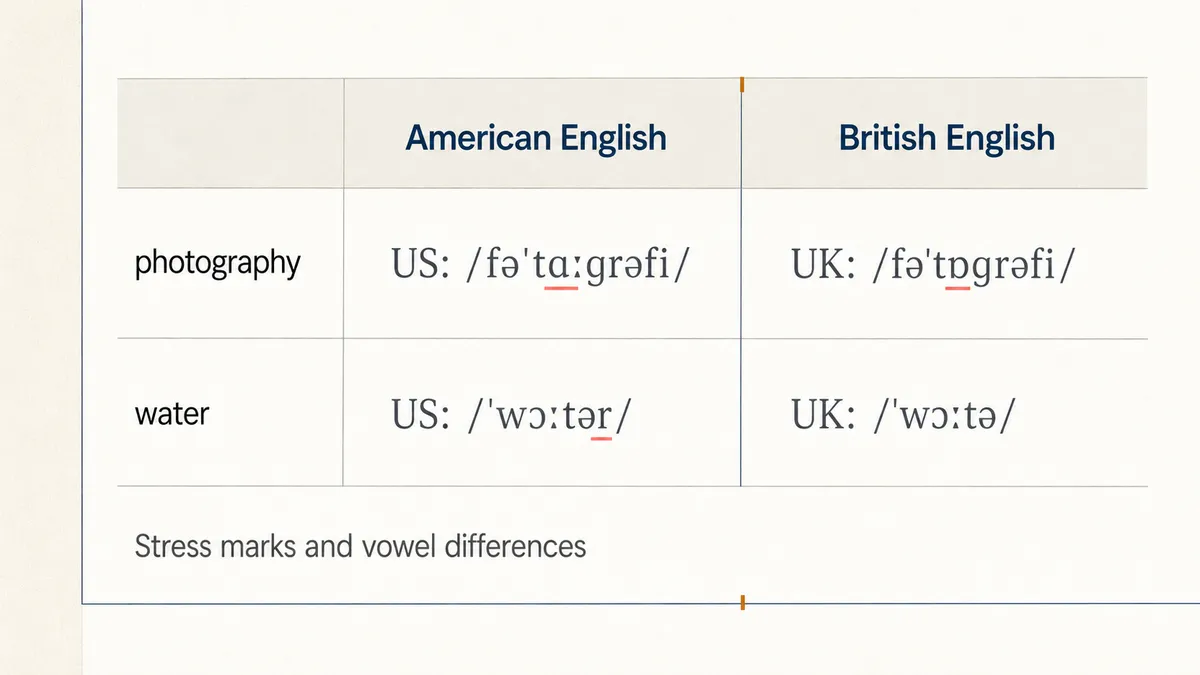
Two ways to explore English phonetics

Standard

Choose Standard when you want dictionary pronunciations for individual words. It uses dictionary lookup and may show more than one pronunciation where alternatives are available. This is a useful starting point for phonetics study: check the sounds, compare accents, and notice stress before practicing a longer passage. Standard is free and does not use Spoken credits.

Spoken

Choose Spoken when you want a context-aware transcription of a sentence or passage. It can account for pronunciation choices that depend on surrounding words, including weak forms and words whose pronunciation changes with meaning. Spoken uses credits and is subject to your available allowance. Treat its result as a suggested reading to check, rather than the only possible way to speak.

Both modes support phonetics practice: Standard gives dictionary forms, while Spoken suggests a contextual reading. Switching keeps your input and clears the old result. Submit again to compare; changing the selector does not run a conversion or spend credits.

How to use the phonetics converter

  1. Enter

    First, paste a short piece of English into the input box. Starting with one sentence makes phonetics easier to follow than starting with a whole article. Choose American or British pronunciation using the US or UK setting, then select Standard or Spoken. Press Show IPA to generate a result for the text you entered.

  2. Listen

    Next, read the transcription beside the original words. Look for stress marks, unfamiliar vowel symbols, and places where the letters do not predict the sound. Use the available pronunciation controls to listen as you study. Connect the written symbols with listening and repetition instead of treating them as an isolated exercise.

  3. Compare

    Finally, change one word and explore English phonetics in context. Consider whether the meaning or rhythm changes, keeping the accent setting consistent. After switching modes, submit again to generate a new transcription.

A phonetics example: the same spelling, different sounds

American and British dictionary pronunciations of car, dance, and schedule

The starting example is “Please read the schedule.” In Standard, schedule appears as ˈskɛdʒul in the US dictionary and ˈʃɛdjuːl in the UK dictionary. This makes pronunciation differences visible without changing the written word. These are the converter’s dictionary entries, not an exhaustive list of regional pronunciations; speakers within either country can use other variants.

The word read also illustrates why phonetics needs context. Standard can list alternatives for its present and past forms. For a phonetics comparison, try “I read every morning” and “Yesterday I read the news” in Spoken. Look at the suggested vowel and check it against the sentence meaning. A dictionary list and a contextual reading serve different purposes.

Build a phonetics practice routine: predict a word’s sounds, check the transcription, and listen. Then try a sentence, focusing on recurring sounds and stress. Begin with familiar symbols rather than memorizing the whole chart.

How can this tool help with phonetics and pronunciation?

Practice

Use phonetics to prepare vocabulary lists, classroom examples, presentation notes, or reading practice. In a phonetics lesson, teachers can compare a dictionary entry with a sentence reading; learners can revisit words that look alike but sound different. The useful result is a clearer question about pronunciation, followed by listening and practice. A transcription alone does not assess your accent or fluency.

Limitations

This phonetics tool takes English text as input. It does not transcribe an uploaded recording, translate another language into English, or convert phonetic symbols back into ordinary spelling. Names, specialist terms, and unusual spellings may need extra checking. If a word is missing or a reading seems wrong, compare a reliable dictionary or ask a teacher before using it as a reference.

Phonetics questions and answers

Phonetics studies how speech sounds are produced, transmitted, and heard. Pronunciation is how a word or sentence is spoken. English phonetics gives you terms and symbols for describing pronunciation. This converter applies phonetics to words and sentences, letting you compare dictionary forms with a suggested reading in context.

No. Phonetics is a field of study, while IPA is a system of symbols used to represent speech sounds. The phonetics converter uses those symbols to display pronunciation. Learning the symbols can support phonetics practice, but the field also includes listening, articulation, and acoustic analysis.

Phonetic transcription represents speech sounds with symbols. In phonetics, it can also use marks to show stress and vowel length. The converter displays English words and sentences in those symbols. Standard provides dictionary pronunciations; Spoken suggests how the text may be read in context.

Yes, Standard is free and uses dictionary pronunciations. Spoken uses credits under the visitor, free account, or paid plan allowances available to you. Switching modes does not spend credits. Check the displayed allowance and any estimate before submitting a Spoken request.

Start with Standard for vocabulary and dictionary alternatives. Choose Spoken for a suggested reading that considers sentence context. For a phonetics comparison, keep the same text and accent setting, then submit each mode separately. Different results can reflect different purposes rather than a simple right-or-wrong answer.

The sounds and transcription conventions can differ between accents. Select US or UK before converting, then keep that setting consistent during practice. Phonetics describes these differences without ranking one accent above the other. Neither setting represents every regional or individual speaker.

No. Pronunciation varies with accent, emphasis, speaking rate, and personal habits. Standard provides dictionary entries, while Spoken suggests a contextual reading. Use either result as a phonetics study reference, and compare it with listening when you need a particular speaker’s pronunciation.

Continue your phonetics practice

Choose the next resource that matches your task.

  • English to IPA

    Use the dedicated Standard dictionary converter.

  • Phonetic spelling generator

    Explore a readable respelling view of pronunciation.

  • Type pronunciation symbols

    Type IPA symbols for your own notes.

  • Presentation pronunciation practice

    Work on the words in your next presentation.

  • Spoken allowances and plans

    Review credit allowances before choosing a plan.

Try the phonetics converter

Return to the tool, start with Standard, and explore phonetics using your own text.

Try the phonetics converter