Why Does "Want To" Sound Like "Wanna"? Where the T Goes
Why want to becomes wanna, where the T goes, and the in-between versions you will hear. Plus the cases where wanna sounds wrong to native speakers.
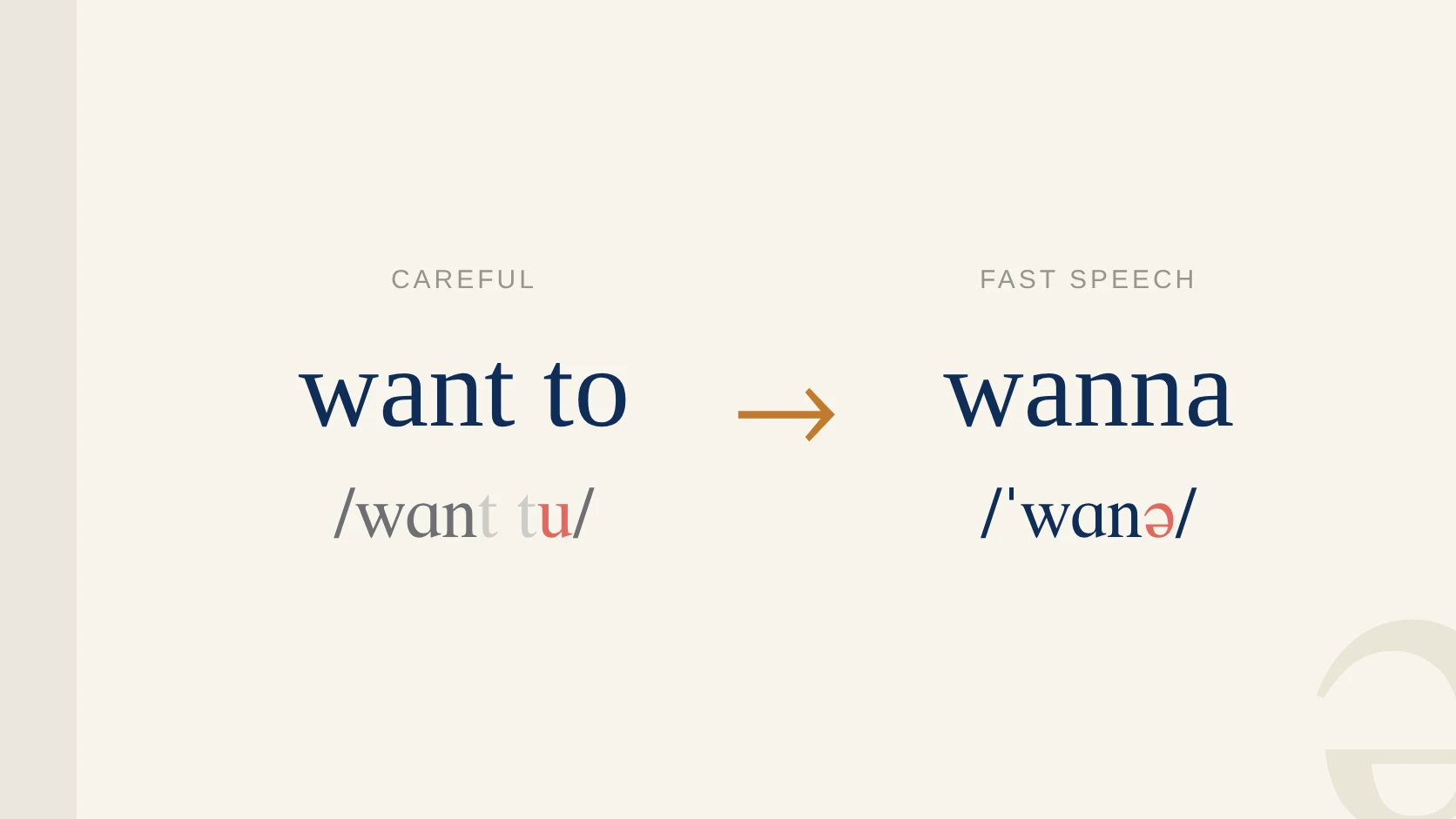
"Want to" sounds like "wanna" because, in fast speech, the T sounds between "want" and "to" drop out and the vowel of "to" shrinks to a quick "uh" (schwa). Careful becomes in American English: the same two syllables, with less inside them.
You know the words "want" and "to." You can read them, spell them, and say them slowly. Then a coworker says "Wanna grab coffee?" and for half a second your brain searches for a word called wanna that you never studied. The sentence is over before you work out it was "Do you want to grab coffee?"
This guide shows what changes when want to becomes wanna, using IPA so you can see which sounds disappear. You will also learn the cases where wanna is not possible (there are rules here, and fluent speakers follow them without thinking), plus how to practice hearing and saying it.
Want To vs Wanna: What Actually Changes
Wanna is the reduced spoken form of want to. Both the Cambridge Dictionary and Merriam-Webster list it as an informal way of writing want to, so it is a recognized form of English, not a mistake or a slang invention.
The difference is easiest to see side by side:
| Written form | Dictionary IPA (word by word) | Spoken IPA in IPAtranslator | What changed |
|---|---|---|---|
| want to | (wanna) | T sounds gone, "to" reduced to | |
| want to (UK) | (wanna) | Same change, British vowel |
Two things happen at once. First, the consonants at the boundary collapse: want ends in /t/ and to begins with /t/, and in relaxed speech those two T sounds usually merge into one. Second, to is a function word, so in an unstressed position it loses its full vowel and becomes the weak form , with the relaxed "uh" vowel called schwa. Linguists call this kind of change vowel reduction (our guide to how to pronounce "to" covers that strong and weak form in detail).
The Versions of Want To You'll Actually Hear
Want to has no single spoken form. Depending on speed, emphasis, and the speaker, you will hear a range of versions, and it helps to recognize all of them as the same phrase:
| You might hear | IPA (US, approximate) | What's different from careful speech |
|---|---|---|
| want too | Nothing: every sound is pronounced | |
| want tuh | The vowel in "to" shrinks to schwa | |
| wahn-tuh | Only one T is pronounced, not two | |
| wanna | No T at all |
Treat these as common variants, not as steps every speaker moves through in order. The careful version is typical of dictation, emphasis, or speaking slowly to a learner. Wanna is typical of relaxed conversation. The versions in between show up everywhere.
The T weakens so easily because of where it sits. In North American English, the sound cluster /nt/ followed by a weak vowel may be pronounced as a nasal flap, a single quick tap with air through the nose, which is why winter and winner can sound the same for many speakers (see flapping). Once its two T sounds merge, want to follows the same pattern as winter: N, then T, then a weak vowel. When the T disappears entirely, the result is a case of elision, the dropping of a sound in connected speech.
Why Want To Sometimes Sounds Like "Wanda"
The "wanda" impression is a listening effect worth taking seriously. In American English, a T pronounced as a quick flap is often heard as a D: the flapping entry notes that butter with a flapped T may be heard as "budder," and that latter and ladder can sound identical. When want to is said quickly with a light tap where the T was, many listeners report hearing something like "wanda." Treat it as one of the variants you may hear, not as a separate pronunciation to learn or a required step on the way to wanna.
The Next Stage After Wanna
The reduction does not always stop at wanna. In fast, relaxed speech, the words around it shrink too, and this is where most listening trouble starts.
In questions, Do you want to...? compresses in layers:
| What's written | What you might hear | IPA (US, approximate) |
|---|---|---|
| Do you want to eat? | Do you wanna eat? | |
| Do you want to eat? | D'you wanna eat? | or |
| Do you want to eat? | Ya wanna eat? | |
| Do you want to eat? | Wanna eat? |
In the shortest version, both the helper verb do and the subject you are gone. "Wanna eat?" is a complete, natural question in casual American English, and the listener rebuilds "Do you" from context.
The vowel in wanna can reduce as well. When wanna is unstressed in a quick sentence ("I wanna go home"), the first vowel may weaken toward , giving something close to . If you can recognize all of these as the same phrase, you have done most of the listening work.
When You Can't Say Wanna
Wanna only replaces want to in specific conditions, and getting these wrong is what makes a learner's wanna sound off even when the pronunciation itself is fine.
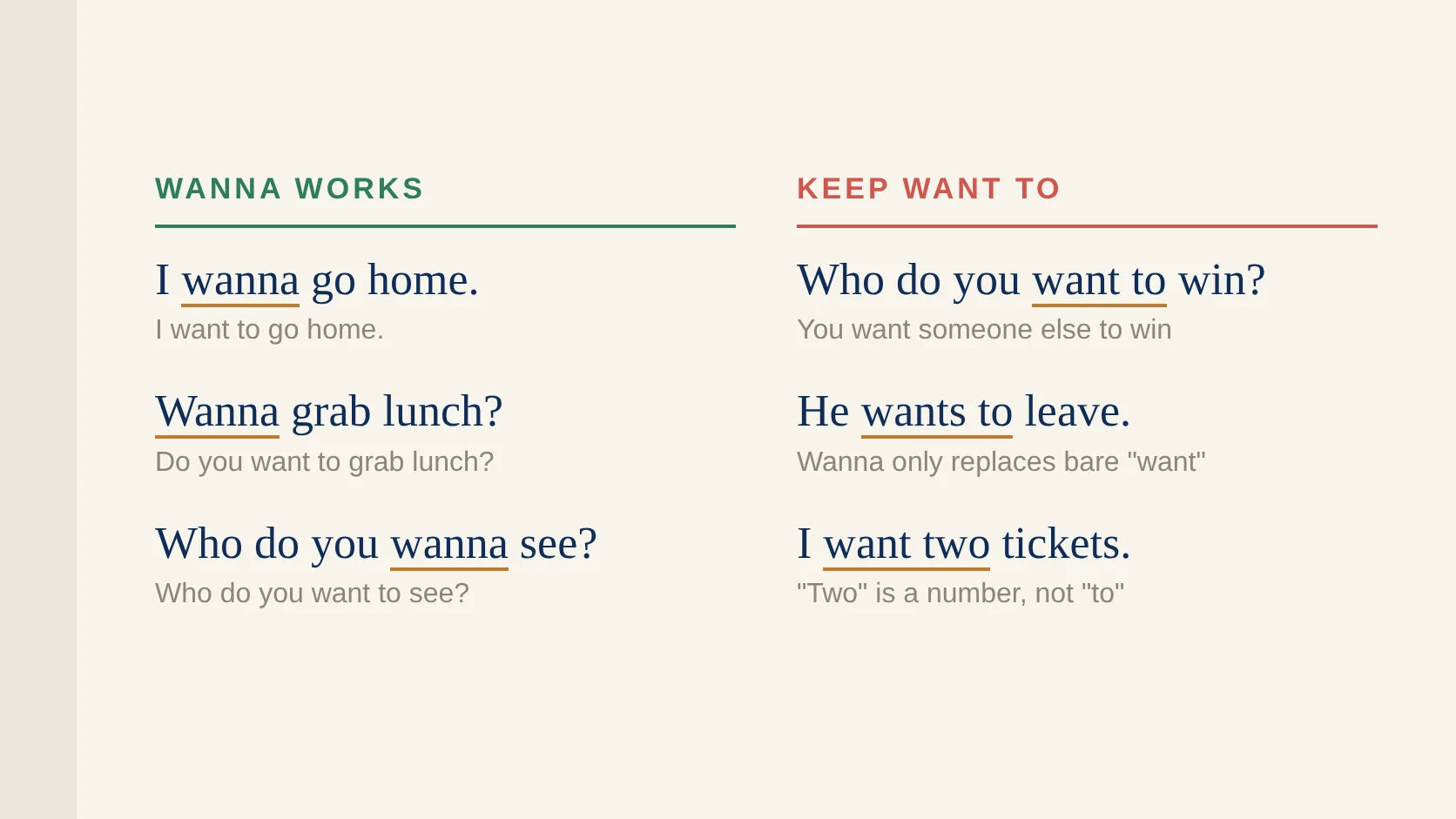
Wanna only works with the bare form "want." He wants to leave does not become "he wannas leave," and she wanted to stay does not become "she wanna'd stay." Those forms reduce differently: wants to usually keeps its S, giving something like .
Wanna needs "want" and "to" to belong together. Compare these two questions:
- Who do you want to see? → Who do you wanna see? (natural)
- Who do you want to win? → Who do you wanna win? (sounds wrong to most native speakers)
In the second question, who is the person you want to do the winning, and that hidden subject sits between want and to in the sentence structure. Most native speakers will not contract across it, a well-known puzzle in syntax often called the wanna contraction. You do not need the theory. Just remember: if the meaning is "I want someone to do something," keep want to.
Wanna doesn't replace "want two." I want two tickets has the number two, which keeps its full vowel and its T. Nobody says "I wanna tickets."
Sentence-final "to" usually keeps more of its sound. In "Sure, if you want to," the to ends the sentence and carries the beat, so it tends to stay closer to its strong form /tu/. You may still hear wanna here in very fast speech, but it is less common.
Wanna is for speaking, not formal writing. Dictionaries label it informal, and like other contractions of this kind it belongs in texts, chat, and dialogue, not in an essay or a work email.
Common Mistakes Learners Make with Wanna
Mistake 1: Over-using wanna everywhere. Once learners discover wanna, some start using it in every position, including he wanna and who do you wanna win. Native speakers tend to notice these. Fix it by checking two things: is it the bare form want, and does to directly connect to the next verb?
Mistake 2: Writing wanna in formal text. Saying in a meeting is completely normal. Typing "I wanna discuss the budget" in a report is not. The spoken form and the written spelling live in different registers.
Mistake 3: Listening only for the word "wanna." Learners who learn the spelling wanna often expect to hear exactly every time, then miss the in-between versions like "wahn-tuh" or the "wanda"-like version with a light tap. They are all the same phrase. Train your ear to accept the whole range, not one fixed sound.
Mistake 4: Practicing wanna only in isolation. You almost never hear wanna alone. You hear it inside d'you wanna, I don't wanna, if you wanna. Practicing the full chunk trains your ear for the version you will actually meet.
How to Practice Hearing and Saying Wanna
Recognizing wanna in real speech is a listening skill first. Production can come later.
- Collect real examples. Put on any American TV comedy and count every wanna in one scene. You will likely hear it more often than you expect, often inside d'you wanna or ya wanna.
- See it in IPA. Paste a few of those lines into IPAtranslator and switch to Spoken IPA. Want to is shown as wanna , so you can compare it with the dictionary forms in our English to IPA converter. One limit to know: the tool shows wanna for every want to, including sentences like "Who do you want to win?" where native speakers keep want to, so apply the rules in this guide yourself.
- Shadow the chunk, not the word. Repeat "d'you wanna," "I don't wanna," "if you wanna" as single units, matching the rhythm of the clip.
- Test the exceptions. Say "Who do you wanna see?" and then "Who do you want to win?" aloud. Hearing the contrast yourself makes the rule stick.
- Move to the next phrase. Once wanna feels automatic, the same pattern explains gonna, gotta, and hafta. Our guide to connected speech rules and examples shows how they fit together.
Frequently Asked Questions
Yes. Wanna is a recognized informal spelling of "want to," listed in major dictionaries such as Cambridge and Merriam-Webster. It reflects how most speakers actually pronounce "want to" in casual speech. Use it freely when speaking, and in casual writing like texts, but avoid it in formal essays and professional documents.
Wanna is pronounced in American English and in British English. Stress the first syllable, then end with a short, relaxed "uh" (schwa). There is no T sound at all. In fast speech the first vowel can weaken too, giving something closer to .
No. Saying wanna is normal, fluent English used by educated native speakers in everyday conversation, including at work. It is a predictable sound change, not careless speech. What sounds unnatural is using it where it does not fit, such as "he wanna" or in formal writing.
In American English, a T said as a quick flap is often heard as a D, which is why "butter" can sound like "budder." When "want to" is spoken fast with a light tap where the T was, many listeners hear something like "wanda." It is one variant you may hear, not a separate word.
No. Wanna only replaces "want to," never "wants to" or "wanted to." "He wants to leave" keeps the S and usually sounds like . In standard English, "he wanna leave" sounds like a grammar mistake.
Avoid wanna when the meaning is "want someone to do something" (Who do you want to win?), usually when "to" ends the sentence, when the word is the number "two," and in formal writing. In all other casual uses of "want to" followed by a verb, wanna sounds natural.
Conclusion: Hear the Slide, Not Just the Word
Want to becomes wanna when the T sounds drop out and "to" weakens to schwa. Between the careful form and wanna you will hear several in-between versions, and in fast questions do you can vanish too, leaving just "Wanna...?" Once you can recognize the whole range, every version you hear is the same phrase at a different speed.
The fastest way to train your ear is to see the spoken form next to the written one. Try it now with a real line: paste "Do you want to grab lunch?" into IPAtranslator, turn on Spoken IPA, and compare what you see with what you hear in your next TV episode.
Author

Categories
More Posts
How to Speak in Public Confidently: A 7-Step Guide
Rehearse your script with IPA to see how words reduce and link, then build confidence with 7 practical steps for pacing, breathing, pauses, and spoken rhythm.
toPhonetics: How It Works and When to Use an Alternative
toPhonetics turns English text into IPA word by word. See its options, what its own FAQ says it does not do, and when a sentence-level alternative fits better.
Daily Pronunciation Practice with IPA and TTS: A 5-Step Method
A 5-step daily pronunciation practice method using IPA and TTS audio — with 15–25 minute routines for beginner, intermediate, and advanced learners.